
Engine History
The Raymond Improved Gas Engine: J. I. Case’s Forgotten Experiment with Gasoline Power
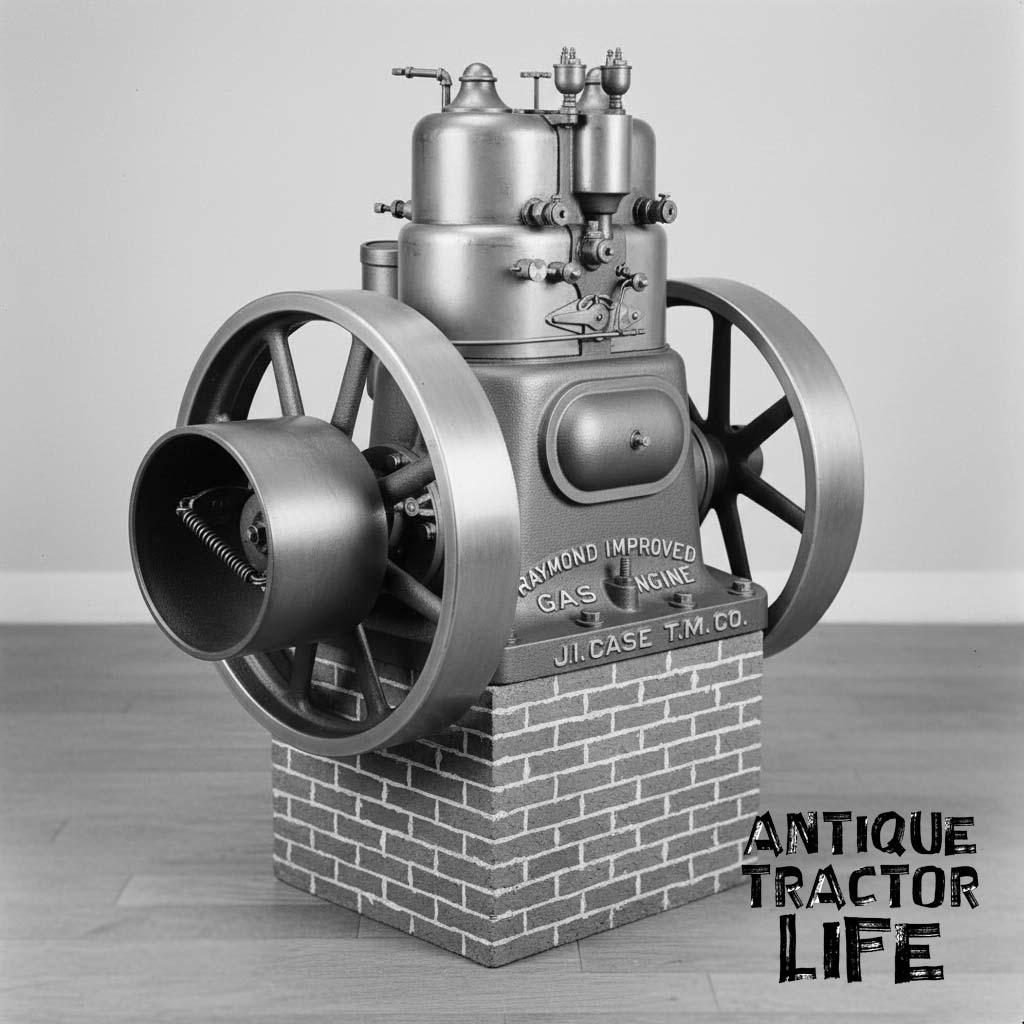
When most people think of the J. I. Case Threshing Machine Company, they think of massive steam traction engines and portable steam engines that powered farms across North America.
But in the 1890s, Case briefly experimented with gasoline engines.
At the center of that experiment was an obscure and fascinating design known as the Raymond Improved Gas Engine.
Today these engines are so rare that many collectors have never encountered one. Yet they represent one of the earliest attempts by a major agricultural manufacturer to explore the potential of internal combustion power.
The Inventor: John W. Raymond

John W. Raymond was a late-19th-century American mechanical engineer and inventor who developed several early internal combustion engine designs during the 1890s.
His work is best known through the Raymond Improved Gas Engine, a design briefly produced by the J. I. Case Threshing Machine Company during its early experiments with gasoline power.
Raymond received multiple U.S. patents for gas-engine improvements, including valve mechanisms, fuel and ignition systems, and starting devices for large engines.
Although his engines were produced only in small numbers and for a short period, his patents show that he was experimenting with advanced engine concepts at a time when gasoline power was still in its infancy, making his work an early step in the transition from steam to internal combustion engines.
Case Enters the Gas Engine Business
In the early 1890s, internal combustion engines were still in their infancy.
Steam power dominated agriculture and industry, but many manufacturers were watching gasoline engines with growing interest. Companies wanted to know whether this new technology might eventually replace steam.
Around 1893, the J. I. Case company began producing engines based on Raymond’s designs.
These engines were marketed as the Raymond Improved Gas Engine and were built at Case’s works in Racine, Wisconsin.
For Case, this was a remarkable step. At the time, the company was the largest builder of steam traction engines in the world. Gasoline engines were still experimental, and few major manufacturers had committed to the technology.
What the Raymond Engines Looked Like

The Raymond engines produced by Case during the 1890s were not the small hit-and-miss farm engines that collectors often associate with early gasoline power. Instead, they were large stationary industrial engines, designed to provide belt power for factories, mills, and other fixed installations.
Case built the Raymond engines under license during roughly the mid-1890s, producing several hundred examples. The engines were offered in a range of configurations, from single-cylinder machines to multi-cylinder engines with as many as four cylinders.

One of their most distinctive mechanical features was the use of rotary valves, a design that was relatively advanced for the time but proved troublesome in practice. Maintenance issues were common, and the engines developed a reputation for being difficult to keep in reliable operation.
Despite these challenges, the Raymond engines represented a serious early effort by Case to explore internal combustion power. The company even considered redesigning the engines in the late 1890s.
That redesign, however, never materialized. Case was heavily occupied with the development of its new side-crank traction engines, which were rapidly becoming a major focus of the company’s engineering resources.
Leadership changes also played a role. Jesse Walrath, Case’s superintendent and an enthusiastic supporter of gasoline engine development, was eventually replaced by George Morris, the engineer responsible for designing the successful side-crank steam traction engines.
With attention shifting back toward steam power, the Raymond gas engine program quietly faded away.
Although several hundred were reportedly built, no surviving examples are currently known, making the Raymond Improved Gas Engine one of the rarest and least understood products ever associated with the J. I. Case company.
A Short-Lived Experiment

Despite their advanced design, Raymond engines were produced for only a short period—roughly 1893 to 1896.
Several factors likely contributed to the project’s brief lifespan.
Steam Still Dominated
Steam engines were reliable, powerful, and profitable for Case. The company had decades of experience building them and an established dealer network to support them.
Early Gas Engines Were Still Developing
Fuel delivery systems and ignition systems in the early 1890s were primitive by modern standards. Carburetors were inconsistent, and ignition systems could be troublesome. For many users, steam was still the safer and more dependable option.
The Market Was Limited
Most factories and farms already had established power systems in place. Internal combustion engines would not become widely adopted until the early twentieth century.
For these reasons, Case quietly ended its Raymond gas engine experiment and returned its focus to steam traction engines and portable engines.
An Early Glimpse of the Future

Although the Raymond engine project was short-lived, it represents an important moment in the history of the J. I. Case company.
It shows that as early as the 1890s, Case engineers were already exploring the potential of internal combustion power.
Within two decades, gasoline engines would begin transforming agriculture. By the early twentieth century, Case—along with many other manufacturers—would eventually move away from steam and toward gasoline and oil engines.
The Raymond Improved Gas Engine stands as one of the earliest steps in that transition.
A brief experiment, perhaps—but one that hints at the future of agricultural power.


0