
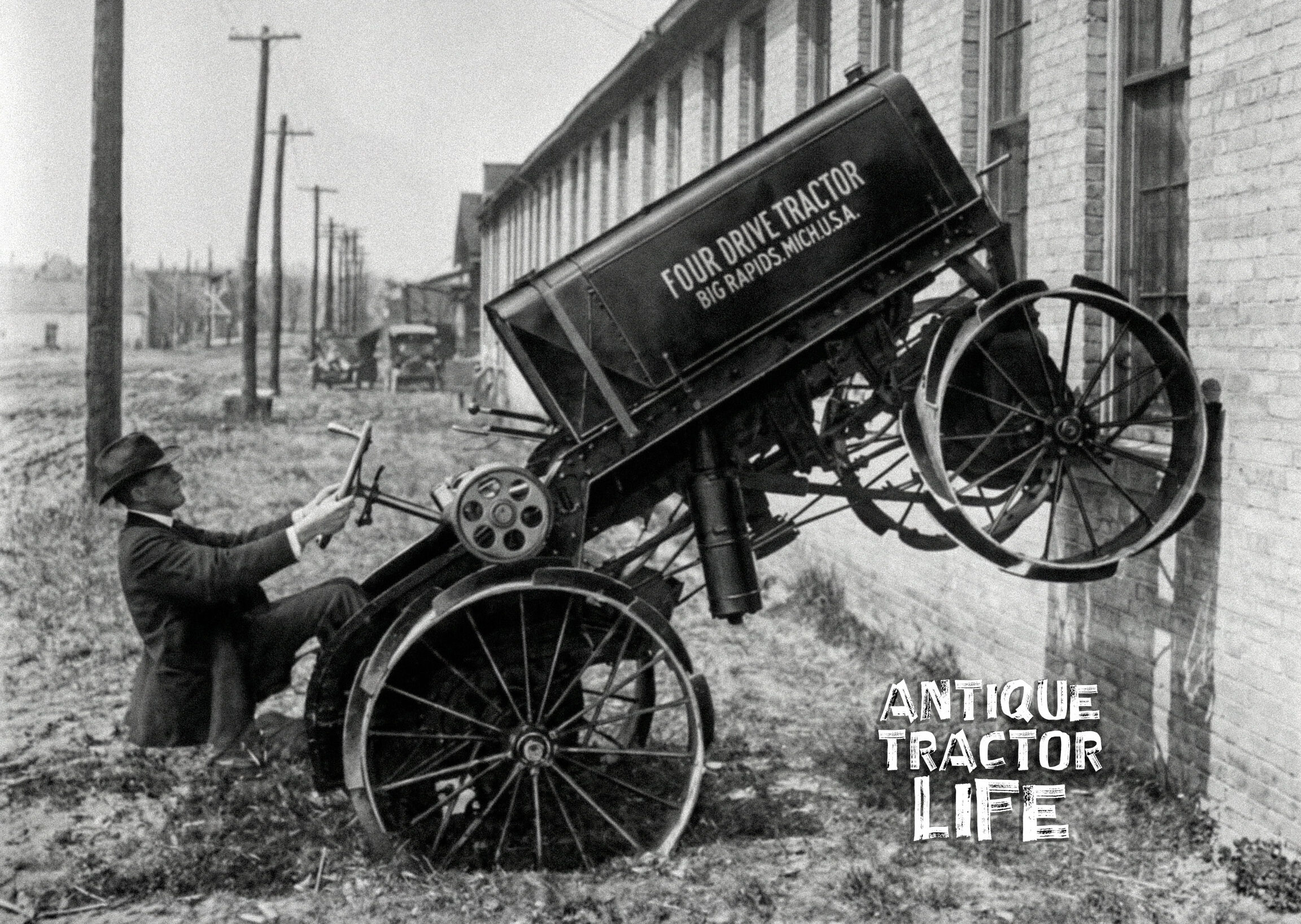
Before four-wheel drive was a selling point, one Michigan farmer built it out of necessity — and what he created was decades ahead of its time.
John Fitch had a problem that no tractor on the market could solve.
His fruit farm near Ludington, in the light sand soil of northern Michigan, was eating tractors alive. The machines of 1910 were two-wheel drive, heavy iron with all their pulling weight riding on two rear wheels and nothing else. In firm ground they worked. In sand, they spun, sank, and quit.
So Fitch did what a certain kind of mechanically stubborn man does. He stopped waiting for someone else to build the right tool and built it himself.
His first attempt was crude by any measure, but the thinking behind it was sound: he took the drive ends of two standard two-wheel drive tractors and married them together with the engine sitting between them. Four driven wheels. All the weight pulling, none of it wasted. The concept worked. Steering it was another matter entirely, but he solved that too, eventually, through the time-tested fifth wheel and live king bolt arrangement used on wagons for generations.
What came out of that process wasn’t a modified tractor. It was a new category.
The Engineering Case

The Fitch Four Drive that went to market wasn’t a cobbled-together experiment. It was a thought-through machine, and the thinking holds up.
Power ran direct from the transmission to a single drive shaft. That shaft drove the rear axle through a Timken-Detroit worm gear on one end. On the other end, a bevel drive gear engaged a crown gear on the live vertical king bolt, which was also the steering pivot. The front axle rode on a fourteen-inch ball race, steel balls, the same principle as a wagon’s fifth wheel. The whole front assembly was sealed and self-oiling through a spiral worm that lifted oil automatically and distributed it across every moving part inside the housing.
No sand. No dirt. No contamination.

The drawbar was mounted at the front of the machine, fourteen inches above the top of the front wheels and ran underneath the rear axle to come out at implement height. The line of draft was nearly identical to a horse team. Weight of load pulled the front end down rather than lifting it.
The mechanical argument for four-wheel drive wasn’t a marketing claim. It was math. In a conventional tractor, idle wheels, wheels carrying weight but not driving consume power just to move themselves. Every pound of machine riding on an idle wheel is power that isn’t going to the drawbar. The Fitch had no idle wheels. One hundred percent of its weight was on driven axles. Every bit of engine output went to pull.
At six thousand pounds, (fifteen hundred per wheel), the weight distribution also meant something practical for road and culvert work that heavier machines couldn’t claim.
What It Did in the Field

The Wichita National Tractor Demonstration gave the Fitch Four Drive its proving ground.
The test: one hundred acres of continuous plowing. Seven inches deep. Gumbo soil. Sixteen inches of wild flax on the surface. Five old straw stacks to turn under. No stops.
They completed it in eighty-eight hours.
Somewhere in the middle of that run, around eleven o’clock one night, the rain came in and didn’t quit until after daylight. Anyone who attended the Wichita show remembered what the roads looked like the next morning. The Fitch ran through all of it, through the rain and for sixty hours afterward without stopping.
That’s the kind of field report that means something to the people who read it. Not a demonstration on prepared ground. Not ideal conditions. Mud, flax, straw stacks, and a rainstorm.
The machine also worked the rice fields of California, Texas, Arkansas, and Arizona — under water, running binders and harvesting equipment in conditions that would strand most tractors. Cotton fields. The muck bottoms of the Tulare Lake bed in California, a sunken lake region where the ground offered almost no traction at all.
The pattern was consistent: the worse the footing, the more the Fitch separated itself from everything else.
The Details That Tell You It Was Built Right

Every bearing was Timken, phosphor bronze, or equivalent quality. Gears were chrome-nickel steel, heat treated. Every working part ran in an oil bath, housed away from contamination.
The belt drive arrangement was clean and direct. First gear ran loose on a splined shaft. Engaged one way, it drove all four wheels. Pull a single plunger, disengage it from the traction gear, engage a cross gear, and it drove the belt pulley instead. The governor gave four speed options — 200, 400, 600, or 850 RPM — depending on the work.
That kind of mechanical versatility mattered on a working farm in 1920. A tractor that could plow, pull, and run stationary belt equipment was a complete power plant.
Why This Machine Matters Now

The Fitch Four Drive never became a household name the way Hart-Parr or Fordson did. It was a specialty machine solving a specific problem, and the market for that was always going to be smaller than the market for general farm tractors.
But the engineering logic it demonstrated in 1910 — that four driven wheels outperform two in marginal conditions, that equal weight distribution protects infrastructure, that sealed lubrication extends service life — became foundational to everything that came after it.
John Fitch didn’t set out to be an innovator. He set out to plow his farm.
That’s usually how the real ones start.
Have you encountered a Fitch Four Drive in the field or at a show? We’d like to hear from you.


0