
Antique Engines
Engine History
International Harvester 50 Horsepower Mogul Stationary Engine (1911 – 1917)
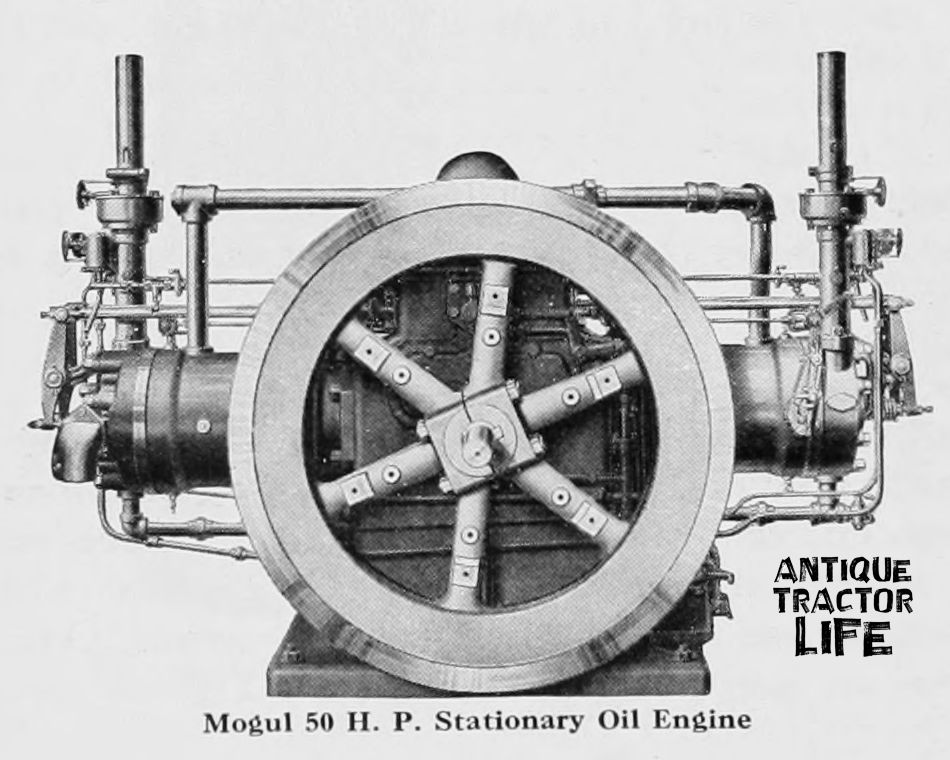
The 50 horsepower Mogul Stationary Engine was the largest in International Harvester’s line of Mogul engines. Built between 1911 and 1917, this massive horizontal, two-cylinder opposed engine was designed to start on gasoline and then switch to kerosene for operation.
A Stationary Giant
Nicknamed the “Giant” Mogul, the 50 HP engine was essentially the stationary version of the engines used in the 45 Mogul Tractor and later the 30-60 Mogul Tractor. This made it one of IH’s most powerful stationary offerings of the era.
Two Valve Configurations
Collectors know the 50 HP Mogul for its two different valve arrangements:
- Version 1: Rocker arm powers the exhaust valve, with an atmospheric intake valve (based on the 45 Mogul tractor design).
- Version 2: Rocker arms on both intake and exhaust valves (based on the 30-60 Mogul tractor design).
This distinction makes surviving examples particularly interesting for mechanical historians.
Ignition System
The 50 Mogul used igniters with make-and-break ignition. It started on a battery and could then be switched to magneto. Like many Mogul tractors of the era, some engines were later converted to spark plug ignition with a high-tension magneto.
Production and Survivors
International Harvester manufactured the 50 HP Mogul from 1911 to 1917, but relatively few were produced. Today, only a handful of these engines survive in either valve configuration, making them exceptionally rare and highly collectible.
Final Thoughts
The International Harvester 50 Horsepower Mogul Stationary Engine represents a fascinating blend of engineering ambition and agricultural history. As the largest Mogul stationary engine, it carried forward IH’s reputation for durability and innovation — and today stands as a prized rarity among collectors.
About International Harvester
International Harvester (IH) was one of America’s most influential manufacturers of agricultural machinery, construction equipment, trucks, and even household appliances. The company was formed in 1902 through the merger of several major players, including the McCormick Harvesting Machine Company and the Deering Harvester Company, and quickly became a driving force in the mechanization of American agriculture.
IH earned its reputation with innovative farm equipment — tractors, combines, and plows — that transformed farming across the U.S. and beyond. The company also expanded into the production of trucks and construction machinery, cementing its role in both agriculture and industry.
Over time, International Harvester went through major changes. By the mid-1980s, financial struggles forced the company to restructure. In 1985, IH sold its agricultural and construction equipment divisions to Tenneco Inc. The following year, the remaining business — primarily focused on trucks and engines — was rebranded as Navistar International Corporation.
Navistar continued building trucks, buses, and engines, carrying forward IH’s industrial legacy. However, it faced its own challenges in later decades, including financial difficulties and legal disputes over engine technologies. In the early 2020s, Navistar entered a new chapter when it was acquired by TRATON SE, a subsidiary of the Volkswagen Group.
From its groundbreaking role in early 20th-century farm mechanization to its later transformation into a global truck manufacturer, International Harvester left a lasting mark on both agriculture and industry.


0